Life has a funny way of reminding you about the passage of time, and for me, one of the clearest signals was when my eyes started playing tricks. Suddenly, reading fine print became a squinting contest, and my arms weren't long enough to hold a book at the right distance. It was the classic sign of presbyopia, that inevitable shift where our eyes lose their youthful ability to focus up close. Like many, I was nearsighted for years, relying on my "regular" glasses for distance. But now, with the added challenge of seeing things up close, I knew I needed a change. My optometrist suggested progressive glasses, touting them as a seamless solution to regain clear vision at all distances. I was intrigued, hopeful even, that these lenses would be the magic bullet I needed.
The concept of progressive lenses sounded absolutely brilliant. Imagine one pair of glasses that could handle everything: driving, looking at your phone, reading a menu. No more switching between distance glasses and reading glasses, no more pushing my glasses onto my head just to read a text. I heard stories of people loving them, how well they worked, and how they seamlessly transitioned from distance vision at the top of the lens to intermediate and then near vision at the bottom. It felt like a modern marvel, a truly elegant solution to a very common problem. I pictured myself effortlessly gliding through my day, seeing everything perfectly, just like I did when I was younger. My first pair of progressive glasses felt like a step into the future of vision correction.
However, my personal experience with progressive glasses didn't quite live up to the initial hype, at least not at first. While some people truly find them awesome, I quickly realized I was in a different camp. To be frank, I started to really dislike them. The promise of seamless vision felt more like a constant struggle for focus. I remember feeling incredibly disoriented, especially when walking downstairs or just moving my head. The world seemed to wobble slightly, and finding the sweet spot for reading or computer work felt like an endless quest. It was frustrating because I really wanted them to work.
I found myself lifting my head in awkward ways to try and read, or even worse, taking them off entirely, which defeated the whole purpose. It was a bizarre feeling, like my eyes and brain just couldn't quite agree on where to look through the lens. Things just felt... weird. I thought maybe I needed a different pair specifically for working at the computer, because trying to use my progressives for extended screen time was a headache-inducing exercise. I kept thinking, "I don't know, I don't feel like they make anything any better." My initial "gu" (guess) that they would be perfect turned into a profound disappointment.
After a few months of trying to adapt, my progressive glasses ended up becoming my emergency backups. They were there if I absolutely needed them, but they certainly weren't my go-to solution for daily life. I simply couldn't stand the constant feeling of disorientation and the effort required to make them work. I'd rather just put my distance glasses on top of my head to read something quickly than deal with the visual gymnastics of the progressives.
My challenging experience with progressive lenses pushed me to explore other avenues for clear vision. I've worn corrective lenses since I was ten, and I've always hated glasses for their general nuisance – especially with my active lifestyle. So, when I started needing reading glasses about seven or eight years ago, I hated those even more. The constant on-and-off, the searching for them, the feeling of getting older – it was all a bit much.
Then, a friend mentioned bifocal contacts. "Hells yes!" I thought. I tried them, and they worked, dammit, they're amazing! It was like I was 35 years old again. The freedom of not having frames on my face, combined with the ability to see both near and far, was incredibly liberating. For a while, these were my absolute favorite solution. They offered a level of convenience and natural vision that glasses, even progressives, couldn't match for me. If you're active and hate glasses, I highly recommend exploring bifocal contacts with your eye doctor.
Despite the success with bifocal contacts, there are times when contacts aren't ideal, or when I just want to relax my eyes. For tasks like extended reading, working at my desktop computer, or simply enjoying a book on the couch, I found myself still needing a dedicated pair of reading glasses. I realized that sometimes, the simplest solution for a specific need is the best. I wanted something comfortable, effective, and importantly, stylish.
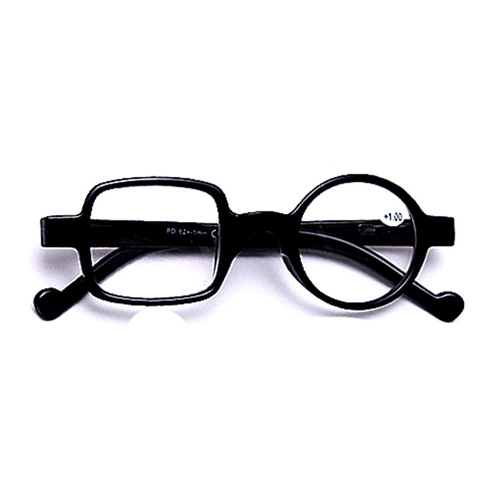
During my search for the perfect pair of dedicated reading glasses, I stumbled upon a fantastic option. I was looking for something that offered clear, high-definition vision without breaking the bank, and that also looked good. I discovered the New Irregular Square Round Frame Reading Glasses For Women And Men Diopter 0 +1.0 To +3.5 Retro HD Presbyopia Eyeglasses 0-Black. These glasses truly stood out. Their retro design with an irregular square-round frame was unique and fashionable, and the HD lenses provided crystal-clear vision for reading and other close-up tasks. It was a refreshing change to find something that combined function with a modern aesthetic.
They come in a range of diopters, from 0 to +3.5, which means there’s an option for various levels of presbyopia. The quality was impressive for the price, and they quickly became my go-to for reading and computer work. It was a relief to have a reliable pair of reading glasses that I actually enjoyed wearing. For anyone exploring stylish and effective options for presbyopia eyeglasses, I highly recommend checking out the selection at Mozaer Fashion. Their range of vision solutions, including these fantastic reading glasses, offers both quality and style.
Through my journey, I've gathered some valuable insights that might help you navigate your own vision correction needs, especially as presbyopia sets in. It's not a one-size-fits-all world, and what works for one person might not work for another.